The health and safety of your landscape often come down to a single decision: how you choose to prune or remove your timber. In Australia, the terminology used by homeowners—and the methods used by contractors—can be the difference between a thriving garden and a heavy fine from the local council.
Understanding the distinction between tree removal vs. tree lopping is critical. While “lopping” is often used as a catch-all term for cutting branches, in the eyes of a certified arborist, it represents a dated, often harmful practice. Conversely, professional tree removal or “target pruning” follows strict Australian Standards ($AS\:4373-2007$) to ensure structural integrity and legal compliance.
This guide explores why “lopping” might be illegal on your property, the inherent dangers of the practice, and how to choose the right arborist services to protect your investment.
See more: What Is Stump Grinding and Why Should You Consider It Over Full Stump Removal?
What is Tree Lopping? A Dangerous Definition
To understand the conflict, we must define the practice. Tree lopping involves the indiscriminate cutting of tree branches or stems to “stubs” or lateral branches that are not large enough to assume the terminal role. It is often performed to reduce the size of a tree quickly and cheaply.
The Mechanical Failure of Lopping
When a tree is lopped, it suffers a biological shock. Unlike professional pruning, lopping removes the tree’s energy-producing canopy too abruptly. This triggers a survival mechanism where the tree produces “epicormic shoots”—fast-growing, weakly attached branches.
Why Lopping is Not Professional Pruning
- Indiscriminate Cuts: Lopping ignores the tree’s natural defense zones.
- Stub Creation: Leaving stubs prevents the tree from “sealing” the wound, leading to decay.
- Vulnerability: It leaves the tree susceptible to pests, diseases, and UV scalding.
Tree Removal vs. Tree Lopping: Key Differences
While both involve chainsaws and heights, the methodology and outcomes couldn’t be more different.
| Feature | Tree Lopping | Professional Tree Removal / Pruning |
| Objective | Short-term height reduction | Long-term health or safe extraction |
| Technique | Heading cuts (cutting between nodes) | Thinning or removal at the branch collar |
| Regrowth | Rapid, weak, and dangerous shoots | Controlled, natural growth patterns |
| Safety | High risk of future limb failure | Structural integrity is prioritized |
| Legal Status | Often prohibited by local councils | Generally compliant with permits |
Why “Lopping” Might Be Illegal on Your Property
In Australia, trees are protected by Local Government Area (LGA) regulations and Tree Preservation Orders (TPOs). Most councils across Sydney, Melbourne, Brisbane, and Perth have strict guidelines that explicitly forbid lopping.
Violation of Australian Standards
The Australian Standard for the Pruning of Amenity Trees ($AS\:4373-2007$) is the benchmark for the industry. This standard explicitly discourages lopping because of the damage it causes. If a contractor performs work that violates this standard, the homeowner can be held liable for “malicious damage” to a protected species.
Heavy Council Fines
Property owners found to have lopped protected trees without a permit—or via a method that compromises the tree’s health—can face fines ranging from $2,000 to over $50,000, depending on the significance of the tree and the state jurisdiction.
The Role of the “Significant Tree” Register
Many Australian properties house trees that are part of a “Significant Tree Register.” Lopping these specimens is almost always illegal and can lead to criminal charges in extreme cases of environmental vandalism.
The Hidden Dangers of Tree Lopping
Beyond the legal ramifications, lopping creates a ticking time bomb on your property.
1. Increased Risk of Limb Drop
The rapid regrowth (epicormic shoots) following a lop is not deeply anchored in the wood. As these shoots grow heavy, they are significantly more likely to snap off during high winds compared to original branches.
2. Starvation and Decay
Leaves are a tree’s food source. By removing too much canopy, you effectively starve the tree. The remaining stubs often begin to rot internally, with the decay traveling down into the main trunk, necessitating a total (and expensive) tree removal later.
3. Property Devaluation
A “topped” or lopped tree is visually unappealing. It looks butchered and unnatural, which can negatively impact the curb appeal and market value of an Australian home.
When is Tree Removal the Better Option?
If a tree has become too large for its space or is structurally unsound, “lopping it back” is never the answer. Instead, a Certified Arborist (AQF Level 3 or 5) will recommend one of two paths:
1. Directional Pruning or Thinning
This involves removing specific branches back to the branch collar. It allows wind to pass through the canopy (reducing “sail effect”) and keeps the tree healthy while managing its size.
2. Complete Tree Removal
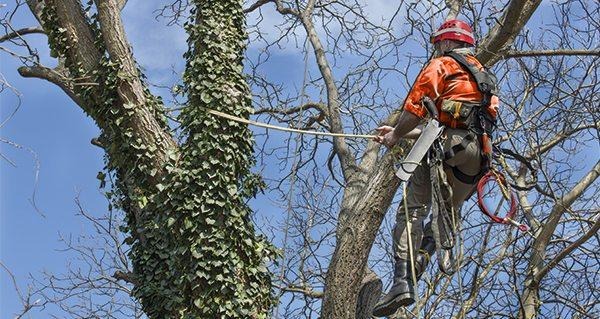
If the tree is a “nuisance species,” is dying, or poses an immediate threat to a dwelling, total removal is the safest route. This process involves:
- Sectional Dismantling: Dropping the tree piece-by-piece using rigging.
- Stump Grinding: Ensuring the root system is neutralized.
- Site Remediation: Clearing debris to prevent fungal growth.
How to Choose a Certified Arborist in Australia
To avoid the legal and physical risks of lopping, you must hire a professional. Here is a framework for vetting your contractor:
- Check Qualifications: Ensure they hold at least an AQF Level 3 in Arboriculture. A “tree lopper” is often an uncertified laborer; an “arborist” is a trained professional.
- Insurance Coverage: Ask for a Certificate of Currency for Public Liability Insurance (minimum $10 million) and Workers’ Compensation.
- Reference AS 4373-2007: Ask the contractor if their work complies with the Australian Standard for pruning. If they hesitate, do not hire them.
- Council Liaison: A professional arborist will often help you navigate the permit application process with your local council.
Common Mistakes to Avoid
- Hiring the Cheapest Quote: Low prices often reflect a lack of insurance and a “lop and drop” mentality that leaves you with legal headaches.
- Topping for “View Restoration”: Cutting the top off a tree to see the ocean or hills often results in a wall of thick, ugly regrowth that blocks the view even faster.
- Ignoring the Root Zone: Tree health isn’t just about the branches. Heavy machinery used by unprofessional loppers can compact soil and kill the tree from the bottom up.
Frequently Asked Questions (FAQ)
Is tree lopping the same as pruning?
No. Pruning is the strategic removal of specific plant parts for health and structure. Lopping is the indiscriminate cutting of branches to stubs, which is harmful to the tree.
Can I be fined for lopping a tree on my own land?
Yes. If the tree is protected by a Tree Preservation Order (TPO) or is a certain height/girth specified by your local Australian council, you need a permit to perform any significant works.
Why do people still offer lopping services?
It is a fast, low-skill way to make money. Unqualified contractors exploit homeowners’ lack of knowledge regarding tree biology and local heritage laws.
How much does professional tree removal cost in Australia?
Prices vary based on tree size, location, and complexity, but generally range from $800 to $5,000+. While more expensive than a “quick lop,” it saves money by avoiding future failures and fines.
What should I do if my tree was already lopped?
Contact a Level 5 Consulting Arborist. They can perform “restorative pruning” over several seasons to try and establish a new, stronger lead branch and manage the decay.
Conclusion: Prioritizing Safety and Legality
When weighing tree removal vs. tree lopping, the choice is clear: lopping is a high-risk practice that offers no long-term benefits. It compromises the safety of your property, devalues your landscape, and can lead to significant legal penalties under Australian law.
Investing in a Certified Arborist ensures that your trees are managed with scientific precision and legal compliance. Whether you need a strategic prune to save a beloved gum tree or a complex removal of a hazardous palm, professional intervention is the only way to ensure a safe and beautiful outdoor space.
Internal Linking Suggestions:
- Learn more about our [Emergency Tree Removal Services] in your area.
- Read our guide on [How to Apply for a Council Tree Permit] in Australia.
- Discover the [Benefits of Stump Grinding] after a tree removal.
External Reference Suggestions:
- Arboriculture Australia (National Peak Industry Body)
- Standards Australia: AS 4373-2007 (Pruning of Amenity Trees)